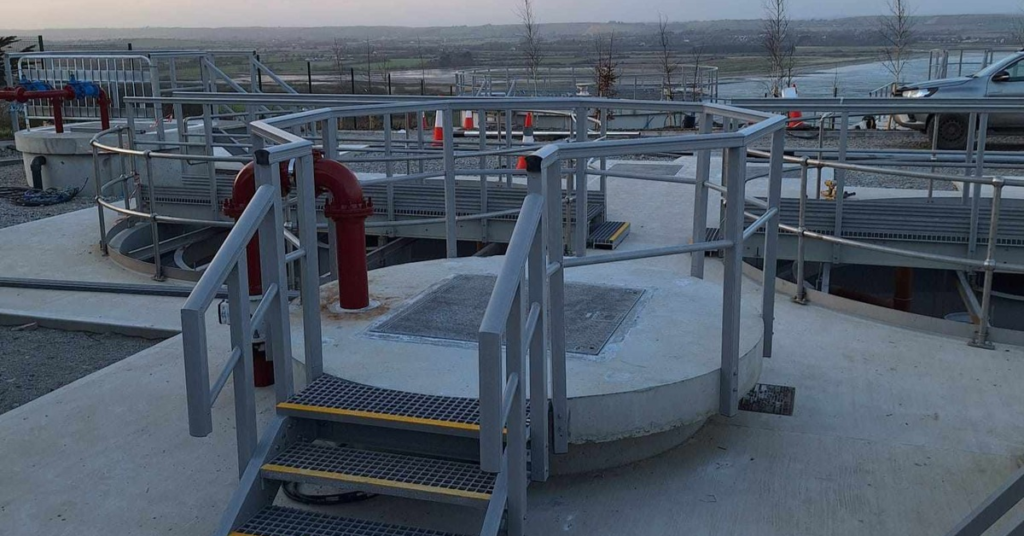
Ireland’s Growing Wastewater Infrastructure: Why Material Selection Matters
Ireland’s next generation of wastewater infrastructure will need to perform for decades. That makes material selection for access platforms, flooring and grating an early design decision, with consequences for safety, maintenance and long-term cost.
On 16 November 2026, Uisce Éireann announced the start of preliminary construction works on the Greater Dublin Drainage Project. The scheme includes a wastewater treatment facility at Clonshaugh with capacity equivalent to 500,000 people, alongside a new sewer network, pumping station and marine outfall. Uisce Éireann says the project will help provide capacity for up to 185,000 new homes. Main works are expected to begin in 2028, with completion planned for 2031.
The announcement brings a wider engineering question into focus: how should the industry specify components that maintenance teams will rely on long after construction finishes?
Wastewater environments place particular demands on materials
A single treatment site can contain wet walkways, chemical dosing areas, tanks, channels and exposed maintenance routes. Components in these locations may face moisture, corrosive atmospheres, cleaning agents and changing temperatures. The relevant exposure conditions vary from one part of a plant to another.
For this reason, material selection needs to start with the environment and the intended duty. A correctly specified steel system can perform well, but coatings or other corrosion protection may need regular inspection and maintenance. Glass Reinforced Plastic (GRP) offers an alternative for suitable applications because its corrosion resistance comes from the composite system itself. Its performance still depends on the resin, reinforcement and actual chemical exposure.
Engineers should therefore assess each component against the site’s chemical conditions, operating temperature, structural loads and maintenance requirements. A general statement that a material is ‘corrosion resistant’ is not a substitute for product-specific evidence.
Maintenance access should be designed from the outset
Wastewater facilities need safe access to pumps, valves, instrumentation and treatment equipment. When walkways or platforms are left until late in the design process, they can conflict with pipework, restrict equipment removal or make routine inspections unnecessarily difficult.
Early coordination allows the access arrangement to influence the layout. Designers can establish required clearances, changes in level, point loads and routes for removing plant components before fabrication begins. Bespoke GRP platforms, grating, staircases and handrails can then be designed around these constraints, with structural checks completed for the actual installation.
A useful access design review should ask:
- Who will use the route, how often and while carrying what equipment?
- Which distributed, concentrated and maintenance loads must the structure support?
- How will drainage, contamination and slip risks be managed?
- Can pumps and other components be lifted or removed without obstructing the route?
- How will the system be inspected and maintained while the facility is operating?
Whole life cost goes beyond the initial quotation
A material with a lower purchase price will not necessarily offer the lowest cost over an asset’s service life. Installation access, lifting requirements, protective coatings, inspection intervals, refurbishment and replacement all affect the eventual cost to the operator.
GRP will reduce corrosion-related maintenance and, because it is relatively lightweight, simplifies handling and prefabrication for some access structures. The fair comparison is between systems that satisfy the same functional requirements, with their likely maintenance and replacement needs assessed over a consistent period.
Routine checks still matter. Even corrosion-resistant grating and flooring may require cleaning, inspection of fixings and review of surface condition as part of a site’s maintenance programme.
Environmental claims need evidence for the actual product
Sustainability decisions should be supported by measured information rather than broad claims about one material being greener than another. Transport distance, manufacturing inputs, service life, maintenance and end-of-life arrangements can all influence a project’s environmental assessment.
Relinea’s GRP Access Platforms have a third-party verified Environmental Product Declaration (EPD), published in accordance with EN 15804+A2 and ISO 14025. This provides product-specific environmental data that project teams can use in an appropriate assessment.
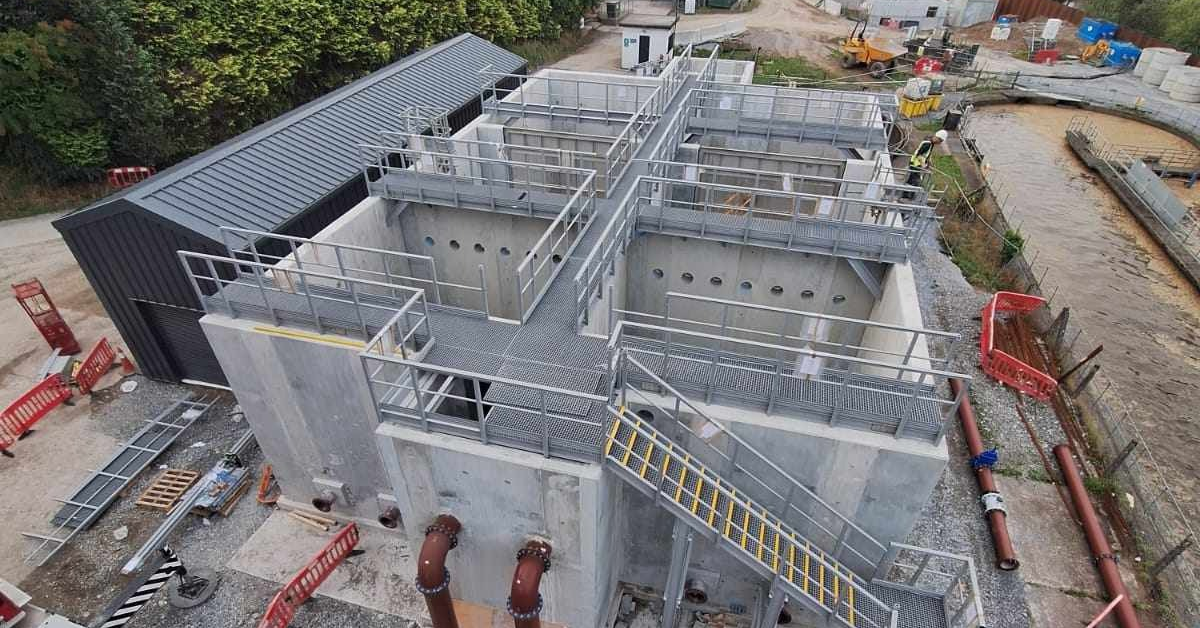
Relinea experience at Macroom Wastewater Treatment Plant
Relinea has worked with Glanua several projects, including the Macroom Wastewater Treatment Plant upgrade in County Cork. The scope included GRP access platforms, staircases, walkways and handrails designed for moisture and chemical exposure. The project also involved platforms spanning up to six metres over the IFAS chamber, requiring careful structural design and integration with surrounding equipment.
The Macroom installation illustrates the level of coordination needed for access infrastructure in a treatment environment. Its design requirements are project-specific, but the broader lesson applies widely: routes, loading and exposure conditions should be established before a material or platform configuration is selected.
A practical approach for future wastewater projects
Ireland’s planned wastewater investment creates an opportunity to build long-term operational needs into infrastructure from day one. For access platforms, grating and flooring, a strong specification should document the working environment, design loads, expected use, inspection requirements and supporting product evidence.
Relinea works with engineers, contractors and operators to design, fabricate and install GRP access solutions for water and wastewater facilities. If you are planning a new treatment project or upgrading existing infrastructure, our team can review the access requirements and advise on a suitable GRP solution.
Discuss your wastewater access project with Relinea: www.relinea.com/contact-us/
How GRP Helps Reduce Environmental Impact in Water & Wastewater Projects